June 19, 2010

The Paw Paw Tunnel


Our first field trip of the season ended at the Paw Paw Tunnel on the C&O Canal in Maryland. We walked slightly over a half-mile from the parking lot.

Completed in 1850, the tunnel provided a shortcut for the canal in a place where the Potomac River twisted and turned through the mountains.

June 18, 2010

Orange Lilies

Daylilies in Fairfield

flowers

June 17, 2010

A Horse is a Horse Of Course

As far as I could tell, this one is not a talking horse.

horse in barn window

June 16, 2010

Jesse McNeill

Here we see a carte-de-visite photo of Jesse McNeill, who took over the leadership of McNeill's Rangers when his father was killed near Mount Jackson in 1864. I found a 3-page biography of Jesse in Faces of the Confederacy: An Album of Southern Soldiers and Their Stories by Ronald S. Coddington.

The portrait of Jesse stands out among the pictures in the book for it's laid-back yet insolent-looking pose. But Jesse turned out to be talented and daring, successfully capturing two Union generals in a dramatic raid in Maryland.

After the Civil War, Jesse appears to have been surprisingly modest, not commenting publicly on the raid until 1907, when he credited "the brave, heroic band of men" that he had the honor to command.

Fort Mulligan, Petersburg, WV

Fort Mulligan is a well-preserved Civil War fort perched high on a hill. Originally built by Union forces to protect the South Branch Valley, it was later abandoned and then used by Confederates. Today it overlooks the Grant County Hospital and the town of Petersburg, with mountain views beyond. This is not very far from Moorefield but it was not included on our field trip there.

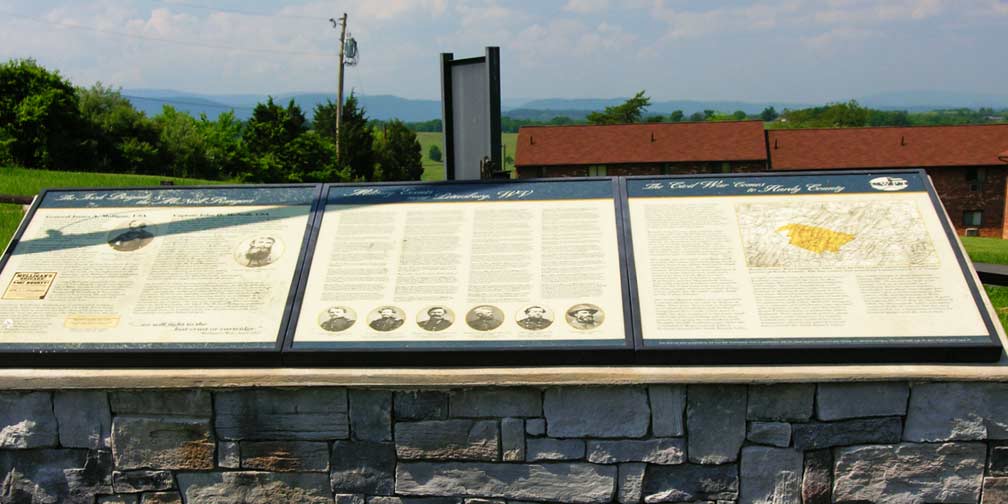
A number of interpretative signs present the fort's story. Don't miss the three-part sign on the wall between the flagpoles.

Since I've been following the history of McNeill's Rangers, I was interested in the markers dealing with their exploits. A detailed story of the rangers is on one of the markers (see yesterday's post on Fort Mulligan). Here's a much shorter version from a section called Civil War comes to Hardy County.
"McNeill’s Rangers was a company of Confederates who operated with impunity in the area and did much to thwart Federal efforts to protect the B&O Railroad. Their many small actions, along with larger scale incursions by regular Confederate cavalry resulted in a more determined effort on the part of Federal forces to hold the South Branch Valley."
Grant County, by the way, was once part of Hardy County. When it split off in 1866, it was named after U.S. Grant.

In 2008, I flew in to Petersburg Airport in a small plane with our friend Gordon. Petersburg WV is a much smaller city than Petersburg VA.

June 15, 2010

Story of McNeill's Rangers told at Fort Mulligan

At Fort Mulligan in West Virginia you can read the story of John "Hanse" McNeill on a marker under the flag pole. It shares a panel with The Irish Brigade and Union General James A. Mulligan.

"Captain John H. McNeill, CSA John Hanson McNeill was born June 12, 1815, a short distance from Moorefield. In April of 1861, he was commissioned by Missouri Governor Jackson to raise a company of militia and join General Price. Twice commended for bravery, McNeill was wounded at Lexington and later captured, along with his son Jesse. After a daring escape from prison, McNeill and his son returned to Hardy County and once again tool up the cause of the Confederacy.
Captain McNeill’s company of 1st Virginia Partisan Rangers was accepted into Confederate service on September 24, 1862. It was merged into the 18th Virginia Cavalry, and then part of McNeill’s command was reassigned in February of 1863. The other section remained under McNeill’s personal command. Few groups were more effective that the some 210 men of the McNeill Rangers. Hardy County served as their main base of operations. The McNeill Rangers were considered “bushwhackers” by many Union generals as they pursued their objectives—creating general havoc among the Federal troops, disrupting traffic and communications on the B&O Railroad, and foraging for beef cattle to supply the Confederate armies.
On October 3, 1863, having learned of a wagon train bringing supplies to Union troops around Harrisonburg, the McNeill Rangers attacked a force of Federals guarding the bridge over the Shenandoah. They captured the bridge and some 60 Union prisoners, but in the confusion McNeill was mortally wounded. He was taken to the home of a Methodist minister where, knowing they were in danger of capture, he said “Goodbye, my boys, leave he to my fate. I can do no more for my country.” He was later smuggled to Harrisonburg where he died November 10, 1864. The McNeill Rangers continued under the leadership of his son Jesse, who never forgot what his father taught him—in leading a raid, one should always look well for a getting-out-place before going in."

[View all the markers using their Next link]
FaceTweet it!

June 14, 2010

McNeill's Cumberland Raid

McNeill's Rangers, led by Jesse McNeill, pulled off a daring raid in which they captured two Union generals in Cumberland, Maryland. Our class traveled to Cumberland to see where this took place. The town has changed since 1865, of course, and the hotels where the generals were taken prisoner are no longer there. woman hold chart

Below we see an old historical marker that was originally mounted on the former Revere Hotel. It was torn down in 1965 and the site is now a parking lot and fast food restaurant.

Capture of Generals B.F. Kelly and George Crook
— Nights, February 21–22, 1865 —
A company of Confederates, young men from Cumberland, Maryland, Hampshire and Hardy Counties, West Virginia, captured several picket posts, obtained the countersign “Bulls Gap,” rode into the city, captured two commanding Union Generals, Kelly and Crook, and Adj. General Thayer Melvin, and sent them to Richmond, Virginia, as prisoners of war, without firing a shot.
General Crook was captured in this building, then known as “Revere House.” Generals Kelly and Melvin were taken from the “Barnum House,” (now Windsor Hotel).
General Lew Wallace was stationed here, in command of a large body of Indiana Zouaves; also Brig. General Hayes, later President of the United States.
This most daring episode of the Civil War created a great sensation all over the country, as at the time several thousand Union troops were stationed in Cumberland.
(The Kenneweg Building—formerly old
Revere House—was located on
this site. Razed in 1964.)

Click to see a more recent interpretative sign for McNeill's Raid which was erected nearby.

June 13, 2010

History Students Lost and Found

Civil War Field Trip Near Romney, WV

We stopped at an air strip along WV Route 8 near the Romney bridge. Some members of our car-caravan had gotten separated from the class in a construction zone and were temporarily lost. When they reached Romney they were able to get a cell phone signal and called for clarification of directions. Before long the group reassembled for a lecture here.


The Civil War interpretive marker concerns Captain George W. Stump, CSA. However, our class was not there to study Captain Stump. We were learning about the surrender nearby of many members of McNeill's Rangers after Appomattox. They surrendered at "Sycamore Dale" after negotiating to keep their weapons.

June 12, 2010

Learning Tools, Civil War Tours

Professor Poland devotes an extraordinary amount of effort to pack education into his history field trips. In addition to research, he makes many flip charts and maps, plus he and his wife traverse the entire route ahead of time in order to scout out suitable locations for stops and short hikes.

Here we see a chart listing estimates of the number of partisans or guerrillas in the American Civil War. (Click on the image to see it larger.) And then we have one of his maps, this one dealing with McNeill's Rangers and plans to attack the B&O Railroad. The illustrations depict John "Hanse" McNeill, Brig. Gen. John Daniel Imboden, Maj. Gen. Thomas Lafayette Rosser and Harry Gilmor.

The professor always cautions us that his maps are "not to scale."

June 11, 2010

McNeill's Last Charge

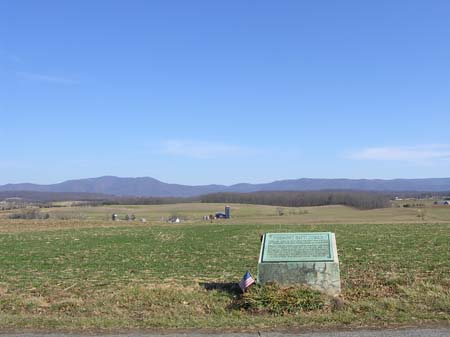
Just south of Mount Jackson, Virginia stands this marker. In the distance you can see the present-day bridge over the North Fork of the Shenandoah.

McNeill's Last Charge

In the predawn darkness of 3 Oct. 1864, Capt. John Hanson McNeill led thirty of his Partisan Rangers, including local resident Joseph I. Triplett, against a hundred-man detachment of the 8th Ohio Cavalry Regiment that was guarding the Meems Bottom bridge on the Valley Turnpike. The attack ended in fifteen minutes with most of the guard captured and McNeill, among the best-known Confederate partisan commanders, mortally wounded. Taken first to the Rev. Anders R. Rude’s house a mile south, McNeill was moved on 20 Oct. to Hill’s Hotel (Stoneleigh) in Harrisonburg, where he died on 10 Nov. His body was later reinterred in Moorefield, W. Va., his home.
I've been researching McNeill lately as a follow-up to a field trip in May which covered the exploits of "McNeill's Rangers" in West Virginia and Maryland. See all my McNeill posts.

June 10, 2010

Rude's Hill and Locust Grove

In the Shenandoah Valley between Mount Jackson and New Market rises Rude's Hill, scene of several incidents during the Civil War. A pair of Civil War Trails markers has joined the older historical markers here. The marker on the left deals with Stonewall Jackson in 1862 and the marker on the right deals with actions in 1864 including an attack by McNeill's Rangers which resulted in the death of John "Hanse" McNeill. Since I've been researching McNeill in connection with a history class, I decided to revisit the markers today.

Below (in blue) are excerpts from the markers. (Click on a picture to see a larger version.)

This old house photographed during the early 20th century and still standing about 600 yards north on the west side of the Valley Pike, was occupied at the beginning of the Civil War by a Lutheran minister, Rev. Anders R. Rude. Gen. Thomas J. “Stonewall” Jackson’s small Confederate force went into a defensive position here after retiring from the battle at Kernstown, March 23, 1862... By April 2, 1862, Jackson and his staff occupied the Rude home where they were quartered until April 17. All dispatches from this headquarters bore the dateline, “Rude’s Hill”—a name that has lasted until this day, even though Rev. Rude left the Valley during the fall of 1862.

On Oct. 3. 1864, the famous partisan ranger, Capt. John H. McNeill led a command of approximately 50 men in a predawn attack against a Federal detachment guarding the Shenandoah River bridge. Mortally wounded in this attack, McNeill was carried by his comrades to “Locust Grove,” formerly the Rude home, where he was cared for until removed south to Harrisonburg where he died. During his stay at Locust Grove his disguised identity was uncovered by Gen. Philip Sheridan, now the Federal commander, who reported “McNeill was mortally wounded and fell into our hands. This was fortunate, as he was the most daring and dangerous of all the bushwackers in this section of the country.”

When I read that "Locust Grove" was still standing about 600 yards north, I decided to look for it. I'm pretty sure this is it. The addition has been rebuilt and "insulbrick" siding was installed at some point, but otherwise the architecture matches the old photograph.

This is along Route 11 just north of the Shenandoah Caverns Road.


Cat and a Cabin

Lucky the Cat

June 9, 2010

House where Col. Gilmor was Captured


Professor Poland had arranged a tour of a marvelous historic house in Moorefield and the owner very generously shared the history of the home. His cat Lucky very nearly stole the show, though, greeting every cat-lover in the group.

Link: The Willows/Randolph Place form (PDF) for National Register of Historic Places
The house is the place where Colonel Gilmor, CSA, was surprised and captured in February 1865. Gilmor had been sent to Hardy County to consolidate two partisan units and coordinate an attack on the B&O Railroad, but wound up in a Yankee prison.

Below we see an older portion of the house, originally built of logs and later covered with board siding. Like many historic houses, sections were added over the years.

Links:

June 8, 2010

Overlooking Moorefield

On the day that our class studied McNeill's Rangers, we drove to Moorefield, WV, where John Hanson McNeill organized the unit. Here we were on a hill looking down on Moorefield.

June 7, 2010

McNeill's Rangers Marker in Moorefield

In Moorefield, West Virginia, there's a marker with facts about "General Joseph Neville" (American Revolution) on one side and a summary of "McNeill's Raid" on the other.

John McNeill was originally from Moorefield and returned there during the Civil War and organized a Confederate unit of partisan rangers. After he was killed near Mount Jackson, his son Jesse became leader of the unit, which was by that time called McNeill's Rangers.

McNeill's Raid
Here, 1865, McNeill's Rangers under Lieut. Jesse C. McNeill started raid on Cumberland where they captured Generals Kelley and Crook of the Union Army. The Rangers, organized by Capt. John Hanson McNeill performed many daring deeds.
For the text of the other side, see HMDB.org.

Evening Sounds: Frog Calls

I think Froggie went a courtin' by singing in our pond. Click the arrow to listen.

It was too dark to get much in the way of of visuals except trees and sky but they're nice and peaceful.

June 6, 2010

Weblog Post #2500

I started this blog five years ago, inspired by my daughter Marie's blog. Since this is my 2500th post, I'm averaging 500 posts a year. Some are very short, perhaps just a title and a photo. Others are fairly long and complex. Sometimes I even code tables in HTML in order to keep multiple pictures lined up.

Since June marks the anniversary of my blog, I looked back at my June posts over the years. Last June (2009) included pictures of our trip to the Carolinas and Savannah, plus some old family photos, including one that I inherited of a musical group comprised of Civil War veterans called the the Old Soldier Fiddlers which has since been used in a book called My Old Confederate Home by Rusty Williams. I received my complimentary copy a few days ago. (Thanks, Rusty!)
The June 2008 archive shows our trip to Chincoteague with a stop at Fortress Monroe and a day at Busch Gardens, plus some Civil War tour photos.

In June 2007, my husband had surgery for prostate cancer so I wrote about his hospital stays. Also in that month I shared local photos including Basye and Quicksburg, plus a Civil War field trip to West Virginia (mostly shown on an earlier page of that month's archive).

June 2006 shows a variety of topics including Lexington VA, Glebe Harbor, a visit from Frank's grandsons, my g-g-grandfather's Bible, and a West Virginia field trip covering the Civil War struggle over the Kanawha Valley.

This June has just begun. We've only made vague plans for a vacation but I think we're ready to make a decision and schedule a trip.

June 5, 2010

New Civil War Marker in Wardensville

Markers At Visitor's Center
Wardensville, WV

Between the two historical markers in Wardensville is a new sign telling about Wardensville's role in the Civil War, including incidents involving Confederate guerrillas.

Wardensville
Crossroads of War

During the Civil War, most of Wardensville's two hundred residents supported the Confederacy. Southern guerrillas found friends here. On May 7, 1862, Union Col. Stephen W. Downey arrived here with a mixed force of infantry and cavalry, searching for guerrilla leader Capt. Umbaugh. He was found and killed.
On May 30-31, 1862, the largest number of troops who entered Wardensville during the war — almost 20,000 men under Gen. John C. Frémont — marched by in a steady rain. Frémont and his men were returning to the Shenandoah Valley, from which Confederate Gen. Thomas J. "Stonewall" Jackson had driven them earlier in the month, to face him again (and again suffer defeat) at Cross Keys and Port Republic on June 8-9.
Confederate Gen. John D. Imboden's men unsuccessfully attacked a Union supply train moving through here on December 22, 1862, on its way to Winchester with provisions for Gen. Gustave P. Cluseret. Federal forces had recently destroyed Imboden's camp near Moorefield, and he was gathering provisions for the winter.
On August 5, 1863, Union Gen. William W. Averell led a column of cavalry and artillery through town. He was beginning a raid to destroy gunpowder and salt works in Pocahontas and Greenbrier Counties. Several times during the war, Confederate Capt. John Hansen McNeill led his Rangers through Wardensville to attack union forces in the Shenandoah Valley to the east.
Across the road from you is the Wardensville Cemetery. At least twenty-eight Confederate soldiers and one Union soldier are buried here.
"The citizens of Wardensville were warned that they would be held strictly accountable for any future demonstrations of guerrilla warfare, and plainly informed that they only way in which they could save their houses from conflagration was for them to defend their territory against incursions of all lawless bands of guerrillas."

— Col. Stephen W. Downey, 3rd Maryland Infantry, US.
hans mcneillold picture
Above: Illustrations from the Marker
Capt. John H. McNeillConfederate attack on Union wagon train
The above interpretative marker stands between two roadside markers: Wardensville (see in HMDB.org) and Population Center (also in HMDB).

Left: Roses in Wardensville Cemetery

Hardy County WV Links:


Wishing Prof. Poland a Speedy Recovery

My long-time history professor is in the hospital recovering his strength after having a pacemaker implanted. We wish him the best! I've really enjoyed his on-site history lessons over the past two decades. He teaches at the NVCC Annandale Campus and also through the college's extended learning institute.

Here are a couple of photos from our May 21 tour.
Above: Charles P. Poland, Jr. with Civil War students Pam and Arch in Middletown, VA, starting point for a trip that went into West Virginia and Maryland.
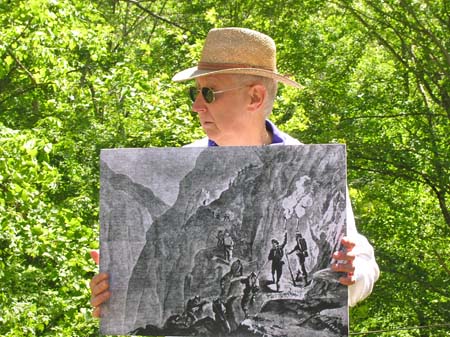
Below: Dr. Poland at the Paw-Paw Tunnel, final stop on that day's field trip.

History Forum Tour

Over the past couple of years I've received a few emails about the Battle of Piedmont. I see that a tour is planned for July 31-August 1 which covers that battle along with Staunton and more. See CWEA.net's 2010 tours.

I found that page through an interesting blog, Shenandoah 1864.

June 4, 2010

Mosby's Farewell

On a recent field trip Professor Charles Poland read the words of John Singleton Mosby at the site of his final meeting with the 43rd Battalion Virginia Cavalry, also known as Mosby's Rangers. Here in Marshall (formerly called Salem) the Rangers disbanded in 1865 after Lee's surrender at Appomattox.
Click arrow to view the video.

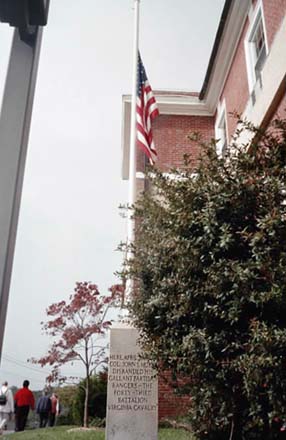
Right: Nearby is a stone marker bearing these words:
Here, April 21, 1865, Col. John S. Mosby disbanded his gallant partisan rangers—the Forty-Third Battalion Virginia Cavalry.
(Location: Main Street (Virginia Route 55) at Frost Street, Marshall, VA.)

June 3, 2010

Creative Warping

I've completed the fifth and final lesson for Virtual University's class in beginning Paint Shop Pro™. These are graphics I made using the warp brush. I used picture tube clip art and gradients to make the picture and then did some selecting warping.

That cake is supposed to look like someone left it out in the rain, and the picture below I call Trouble in Paradise.

oil spill graphic

A Squirrel Ridge Logo

For one of the exercises in my Paint Shop Pro class, I created this little graphic. It combines several techniques and some "picture tube" cartoons.

June 2, 2010

Spring Afternoon on Passage Creek


Passage Creek winds between steep canyon walls in Elizabeth Furnace Recreation Area, George Washington National Forest. I posted photos of it before including


June 1, 2010

Welcome to June

Wow, it's June already! The months go by quickly!

Many of my May posts were related to the Civil War Reenactment in New Market. It was quite a spectacle, full of costumes and interesting faces. And earlier that month I posted Spring scenes. April was full of springtime scenery too including a trip to Pennsylvania.

I took so many pictures this spring that I have a backlog to post. I try to be selective. My problem is once I open the files in Photoshop to resize them, I usually want to brighten them and correct the color and that takes time. I like Photoshop but it's addictive.

On an unrelated subject, a couple of my daughter Lynn's longtime friends have posted a site called 13th Hour Books. It's devoted to science fiction and fantasy publications. We've known Les and Cabin since they were teenagers in Alexandria.