|
| In Etlan, VA |
Sharing with Black and White Weekend


 I don't go to wineries very often because I don't drink, but I've discovered that they often have pretty views so I've decided we should visit one every so often. There are plenty of them in Virginia now, although I can remember when they were few and far between. It wasn't until vintners discovered that European grape vines survive best when grafted to the roots of native grape plants that wine varieties became a viable crop here.

 I assume this sign is warning drivers to slow down because the road makes a dip.
 Today we mourn the loss of our cocker spaniel, who died this morning. He had congestive heart failure that finally overtook his indomitable spirit. Last night he lost the strength to even stand or roll over so we knew the end of his life was near. This morning he still could not walk and we had to carry him to the car.
 Eventually Ben learned a few more commands and could walk on the leash passably well. However, he seemed to be anxious at times.


 The Fun: Browsing antique shops is fun, especially the ones that aren't too fancy. This one had a number of buildings, some of them very rustic.


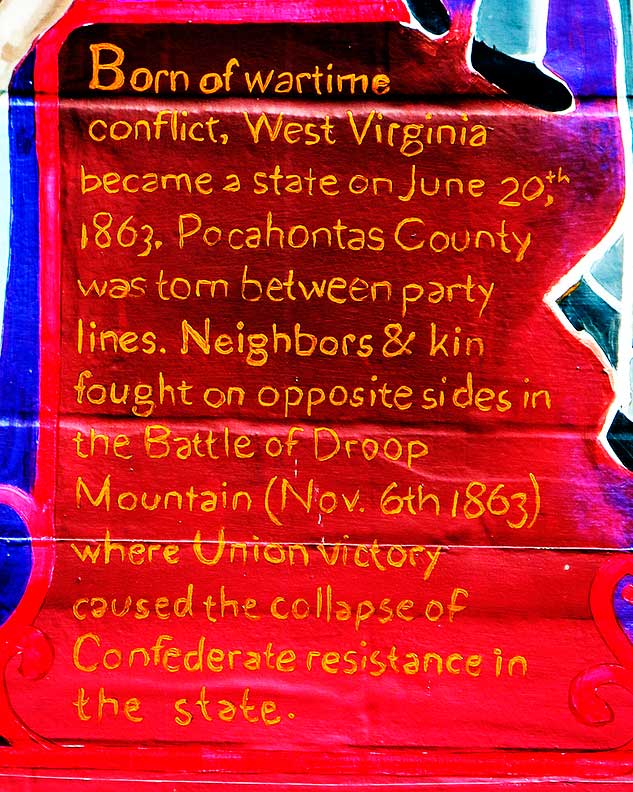 I was moved by this mural in West Virginia. Completed earlier this year to celebrate the 150th anniversary of the end of the American Civil War, it is about "the hometown strife of wartime, more than it is about the more famed losses and victories," according to artist Molly Must. (See article in Pocahontas Times.)
"Born of wartime conflict, West Virginia became a state on June 20th, 1863. Pocahontas County was torn between party lines. Neighbors and kin fought on opposite sides in The Battle of Droop Mountain (Nov. 6th 1863) where Union victory caused the collapse of Confederate resistance in the state."Last week I shared a different mural by the same artist. You can see her experience as a collage artist in the composition of both murals.

 The 1863 Battle of Droop Mountain is interpreted in several ways at the state park. This monument to the men who died as a result of the battle is fairly new, erected for the 150th anniversary of the struggle. It stands near the park office and museum.
  |
| (Click on image to open larger version.) |

The men of the 3rd WV fought their way up this ravine extending their line of battle along the mountainside until they joined with the 28th Ohio. Upon reaching the top, they helped break the Confederate line and pursued the defeated army south towards Lewisburg.You can see other interpretive signs for Droop Mountain on the Historical Marker Database.
 |
| Confederate Graves |
 Behind the Superintendent's Office is a barely-marked cemetery and a museum, located in a charming log building which appears to be a CCC-built cabin. (For those who don't know, the CCC was the Civilian Conservation Corps, a jobs-creating program under Franklin Roosevelt's administration.


 |
| Reproduction of Parrott Rifle |
 The observation tower on Droop Mountain was built of logs the size of telephone poles. They are grayish-brown so a sepia tint looks natural. I'm sharing this with Sepia Saturday.
 |
| Near Hillsboro, West Virginia |
Nearly five months after West Virginia was admitted into the Union, the Confederate army of Brigadier General John Echols still occupied the prosperous Greenbrier Valley region of the new state. From its headquarters in Lewisburg, his army was the foremost defense of the Virginia-Tennessee Railroad, an important Confederate supply line in southwest Virginia.
On August 26 and 27, 1863, the Confederate army had successfully repulsed an attack at White Sulphur Springs by the Federal Army of Brigadier General William W. Averell. In early November, Echols learned that General Averell had left his headquarters in Beverly, West Virginia, and was again moving south toward the railroad. Confederate outposts in Pocahontas County tried to slow the advance. General Echols marched his army north, all through the night, to Droop Mountain to reinforce them.
The reinforcements arrived just in time, for General Averell began his attack early. Throughout the morning, Echols’ outnumbered Confederate army held the high ground and blocked the highway with artillery, but in the afternoon was overwhelmed by the crushing advance of Federal infantry on his left flank. Following the collapse of his lines, General Echols retreated south with the remnants of his command. Federal troops occupied Lewisburg on November 7, 1863, but being burdened by prisoners and captured livestock, General Averell elected to return to his headquarters in Beverly, waiting until early December to lead a third, and ultimately successful, attack on the railroad. Operations in the Shenandoah Valley in the spring in 1864 drew remaining Confederate troops out of West Virginia, thus leaving the new state securely under the control of the Federal government for the remainder of the war.
With more than 400 casualties, (140 Union and approximately 275 Confederate) the Battle at Droop Mountain was one of the last significant Civil War battles in West Virginia.

 You don't need to be a history buff, though, to enjoy Droop Mountain State Park. There are magnificent views, picnic areas, and a play area for children. The lookout tower and some other park buildings were built by the CCC during the Great Depression.


John D. Sutton, 10th West Virginia Infantry, wrote, "The army went into camp in the levels between Mill Point and Hillsboro." These fields were later owned by 2nd Lt. Matthew John McNeel, Company F, 19th Virginia Cavalry, and the Capt. Edgar estate. In plain view of his camp was the large, brick home of Col. Paul McNeel, a member for Pocahontas County in the convention at Richmond that declared secession. Col. McNeel's son was a Confederate captain in McNeil's Rangers. Averell reportedly spent the night either in the home of Col. Paul McNeel or in the Presbyterian Manse.
Eight-year-old C.L. Stulting lived on the farm with Hermannus and Johannah Staulting (ancestors of Pearl S. Buck). Staulting wrote "around 6 o'clock, we were all sitting around the breakfast table unaware of there being any soldiers in our neighborhood, when we heard the firing of army guns just outside of the house."