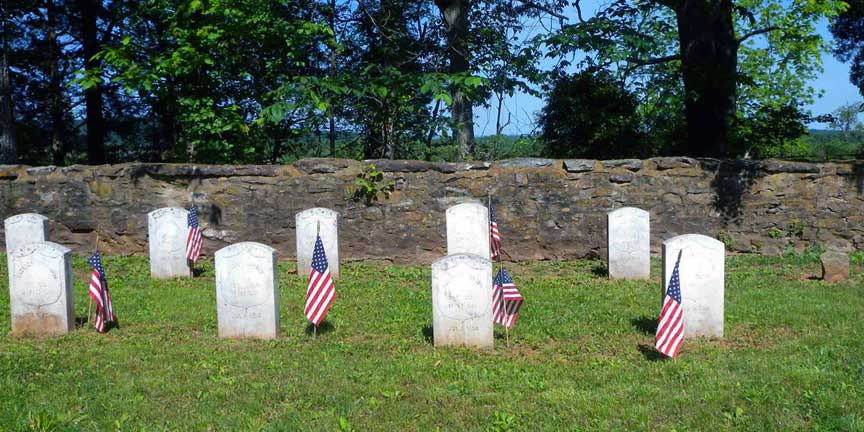
June 19, 2012

Tour President's Hoover's Rapidan Camp


Years ago I took my parents to Skyline Drive and we went on the Rapidan Camp tour. At that time it was offered only one weekend a year in honor of Herbert Hoover's birthday.

Now it's open on weekends and certain other days during the warm seasons. You need to make a reservation in advance because the group travels on a small bus.

For two years I've intended to take my husband on that tour but the schedule did not work out. Finally I got reservations while his sister was visiting us. Rapidan Camp is located at the headwaters of the Rapidan River. The tour leaves from Big Meadows and travels part way down the mountain on a narrow road. Half an hour later the bus reaches the camp, which was once the presidential retreat of Herbert and Lou Hoover.
The camp can also be reached by hiking or horseback. Some visitors drive in from below as far as the gated road and then walk the rest of the way.

The tall hemlocks that were there 20 years ago are gone now, victims of a tiny but powerful pest. A couple of things that I did not remember from my previous visit were that William E. Carson was instrumental in persuading Hoover to locate his retreat here and that First Lady Lou Hoover was a very accomplished woman.

June 18, 2012

Summer White House circa 1930

Rapidan Camp, Shenandoah National Park

The Brown House — Hoover's Cabin

President Herbert Hoover purchased the land for a presidential retreat in 1929. He and his wife liked nature and camping and he loved to fish, so this location in the Blue Ridge Mountains was appealing.

Of the 13 buildings that once stood at Rapidan Camp, only three still exist. They have been restored and two are open for ranger-led tours at select times. The third is used as a staff residence.


The "Creel"

The "Prime Minister's Cabin"

June 17, 2012

Rapidan Camp Introduced by Markers

Hoover's Camp, Shenandoah National Park

Rapidan Camp then & now

Map shows roads, trails, and structures

"Shortly after his election in 1928, Herbert C. Hoover and his wife, Lou Henry, expressed the desire for a weekend retreat – a place where they could find respite from the demands of Washington life and be rejuvenated by “the blessings of nature.” Here among the trees and trout streams they established their rustic summer camp."

Here is peace and quietude.See the rest of the text on HMDB.

June 16, 2012

Boulder and Wild Flowers

In Shenandoah National Park, Virginia

Flowers are soft, flexible and ephemeral.
The rock is hard, unyielding, and just about eternal.
But eventually plants, even delicate ones, can wear down rock
by taking root in crevices and growing with roots gently pressing the rock,
until over the eons, it gives up and becomes soil.

June 15, 2012

Attack of the Woolly Adelgid

At Camp Rapidan, Shenandoah National Park
 Ranger Sally explained that the hemlock trees were destroyed by an insect called the woolly adelgid. The large tree stump shown here used to support a huge hemlock; now small maples are growing in it.

June 13, 2012

Upper Reaches of the Rapidan River

Headwaters at Camp Rapidan
Shenandoah National Park


June 12, 2012

Snapshots of Us at SNP


 We took my sister-in-law to Shenandoah National Park on Friday. It's always been one of my favorite places and now it's only a half-hour drive from our home.

In the last picture, I'm posing with a monument to the CCC at Big Meadows. I've seen a similar CCC statue in Edinburg (VA) at the Forest Service Headquarters.

June 10, 2012

Kustard Stand


Lily in the Kitchen

I put a stem of lilies in some water in the kitchen. The flowers bloomed nicely but I was surprised to find out that the pollen can stain surfaces including skin!

Did you know that lilies are poisonous to cats?

June 8, 2012

A Squirrel in Our Yard

sqirrel under tree
Our new home has squirrels in the yard, not surprisingly. There don't seem to be as many here as we had in Basye ... yet! I imagine we'll see more after I start feeding the birds.

June 7, 2012

Interior Photo of Small Room

It's hard to take a interior shots of small rooms. This is the "bedroom" that Frank used as an office in our house in Basye.

I really need to get a camera that shoots wide angle. Oh, wait, we have one! Maybe I should charge its batteries and see what it can do.

June 6, 2012

In the Yard, Strudel Court

 A woman who saw a listing for our property in Bryce Resort asked for additional photos of the yard. Here are some that I'll send her.


June 5, 2012

Civil War Books I'm Reading

I'm finishing two books for my History 298 Homework.
John Brown
I recommend both these books. The first one is by an excellent teacher at Lord Fairfax Community College, Jon Noyalas. The title tells you what it's about, and anyone interested in Shenandoah Valley history will enjoy it. Midnight Rising is the story of John Brown and his 1859 raid in Harper's Ferry. I'm enjoying the audio version and finding it exciting.

Drama of Field Trips (NVCC style)

June 4, 2012

Lake, Clouds Rising

lake

You can expect to see more pictures of this lake. It's right outside our back door!

June 3, 2012

Our House in Basye

Frank has reduced the asking price for our house in Bryce Resort to $242,000. I think that's too little for a home with a great view and guest apartment, but not many people are looking for resort homes in Virginia right now.  We would also consider renting it to the right people; ie, with good credit and references.

 I wish I could keep the house as a vacation home, but it isn't practical. We were fortunate to live in a resort for eight years and we are still in a lovely place.

June 2, 2012

A Heron in Our Lake

We stopped the car to take this picture. We were across the lake from our house.

June 1, 2012

It's June Already!

 Well, May went by quickly. We've been very busy getting settled in the lake house, although we took a few breaks for sightseeing. Most of my late May posts here have been about the Civil War Field Trips that took up three days in May.

We did have time to host two visits: one from Allison and Dave and one from Peggy and Bill. We took both parties for a walk around the lake, which is not too large to stroll around easily.

Today we expected four visitors and got none! A Comcast repair person just didn't show up; a handyman did the same. A guy who repairs air conditioning said he probably wouldn't make it so that wasn't a big deal, and a friend who planned to drop by called instead and said she wouldn't make it. So it was a disappointing day, kind of strange.

May 31, 2012

Did I Inherit an Interest in Civil War Medicine?

While working on my post about the National Museum of Civil War Medicine, I searched this blog for various entries previously posted about Civil War hospitals. I saw that I had visited quite a few Civil War hospital sites, and I also realized that there were more I had been to but had not written about. Some I visited in my pre-blogging days over six years ago, such as Point Lookout in Maryland. (There was only limited interpretation there of the long-gone hospital and prison anyway, but it's a pleasant place to visit! See the Historical Marker Database page on Point Lookout State Park.)

The large Civil War hospitals are not standing anymore. After all, they were built as short-term solutions and not intended to be permanent. In many cases there are interpretive signs identifying locations. At Mount Jackson there are three markers for the Confederate Hospital that stood there!

Alexandria, Virginia (my hometown for many years) was busy during the Civil War, a Union Army stronghold in Virginia and site of many hospitals during the war. (See Voices from the Past.) Growing up in that area made it easy to become aware of the Civil War, and that's where I first developed an interest in history.  I became aware of the role of hospitals there as a volunteer with Alexandria Archaeology and also as a participant in Civil War Field Trips. (Unfortunately this part of my life was pre-blogging so it's not documented here. Maybe someday...)
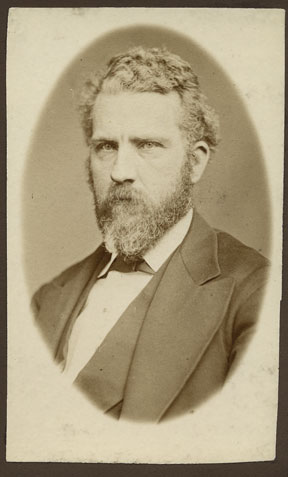
Dr. J. Suiter
Going back even further, I grew up knowing that my father's grandfather was a doctor who was a Civil War Veteran. Eventually I learned that great-grandfather did not enter the war as a doctor but rather went to Detroit Medical College after the war. (One day I should go up to Illinois and read his diaries!) The college is said to have been founded by physicians "whose work with wounded during the Civil War had left them eager to improve the quality of medical education."

My father's sister, who was the genealogist in the family, linked her mother's side of the family to William Morton, a key figure in the development of ether as an anesthetic. Ether and chloroform were important in Civil War surgery.

I knew even less about my mother's ancestors. Mom had mentioned that her grandmother once lived near Xenia, Ohio and talked about riding there in a horse-drawn wagon. This only came up when my daughter decided to go to college near there (at Antioch). And Grandmother Hammer had mentioned that an ancestor was a Presbyterian minister. It wasn't until 2010 that I looked up great-great-grandfather Robert Harper and found that he was not only a minister, but during the Civil War he was in charge of a hospital at Camp Dennison, Ohio. So I guess my interest in Civil War Medicine comes naturally!


May 29, 2012

Museum of Civil War Medicine

Our NVCC class visited the National Museum of Civil War Medicine in Frederick, Maryland. We were there once before but the museum has expanded since then and has even more dioramas to help you picture how the sick and wounded were cared for.

We had a guided tour which was excellent. Notice the wheel-layout of a hospital complex in the foreground of the first photo. That was used at Point Lookout in Maryland.

Once I got an email from a visitor to my CivilWarFieldTrips website asking about Civil War hospitals that can still be seen. There are so many — countless public buildings and private homes were used as hospitals, especially in Virginia which saw numerous battles between 1861 and 1865. Here are some I've written about in the past that are open to the public.
  1. Exchange Hotel in Gordonsville — fantastic, although the exhibit upstairs may be too graphic for some.  
  2. Graffiti House Museum near Culpeper, so called because of the graffiti left by soldiers.  
  3. Bushong Farm at New Market Battlefield  
  4. Old Court House in Winchester.  
  5. Chatham near Fredericksburg 
There are also many buildings used as hospitals that are open occasionally such as old churches and historic homes. Some examples are the Pritchard Farm and Moorefield Presbyterian Church. By the way, Alexandria Archaeology has just published some research on Crimean Ovens, which were radiant heating systems used in a few Civil War hospitals such as Shawnee Springs.

Search for Civil War Hospital on this blog.

May 28, 2012

Lecture at Mt. Zion Church


For the second day of our field trip series last week, we met at Mt. Zion Church near Aldie. Dr. Poland described the battle that took place there when Mosby's Rangers attacked Union troops. Both the church and a nearby farmhouse were used as hospitals to treat the wounded. It was common during the Civil War to use homes, churches, and other buildings as temporary hospitals.

A marker in front of the church tells us that:
On July 6, 1864 nearby, Mosby's Rangers attacked and routed 150 Union cavalrymen. Over 100 Union soldiers were killed, wounded or captured. Mosby had eight men wounded, one mortally."

May 27, 2012

Mt. Zion Church and Cemetery

Mt. Zion near Aldie, VA


Here are markers for some of the Union cavalry men who were killed nearby in an 1864 battle with Mosby's Rangers.