June 3, 2012

Our House in Basye

Frank has reduced the asking price for our house in Bryce Resort to $242,000. I think that's too little for a home with a great view and guest apartment, but not many people are looking for resort homes in Virginia right now.  We would also consider renting it to the right people; ie, with good credit and references.

 I wish I could keep the house as a vacation home, but it isn't practical. We were fortunate to live in a resort for eight years and we are still in a lovely place.

June 2, 2012

A Heron in Our Lake

We stopped the car to take this picture. We were across the lake from our house.

June 1, 2012

It's June Already!

 Well, May went by quickly. We've been very busy getting settled in the lake house, although we took a few breaks for sightseeing. Most of my late May posts here have been about the Civil War Field Trips that took up three days in May.

We did have time to host two visits: one from Allison and Dave and one from Peggy and Bill. We took both parties for a walk around the lake, which is not too large to stroll around easily.

Today we expected four visitors and got none! A Comcast repair person just didn't show up; a handyman did the same. A guy who repairs air conditioning said he probably wouldn't make it so that wasn't a big deal, and a friend who planned to drop by called instead and said she wouldn't make it. So it was a disappointing day, kind of strange.

May 31, 2012

Did I Inherit an Interest in Civil War Medicine?

While working on my post about the National Museum of Civil War Medicine, I searched this blog for various entries previously posted about Civil War hospitals. I saw that I had visited quite a few Civil War hospital sites, and I also realized that there were more I had been to but had not written about. Some I visited in my pre-blogging days over six years ago, such as Point Lookout in Maryland. (There was only limited interpretation there of the long-gone hospital and prison anyway, but it's a pleasant place to visit! See the Historical Marker Database page on Point Lookout State Park.)

The large Civil War hospitals are not standing anymore. After all, they were built as short-term solutions and not intended to be permanent. In many cases there are interpretive signs identifying locations. At Mount Jackson there are three markers for the Confederate Hospital that stood there!

Alexandria, Virginia (my hometown for many years) was busy during the Civil War, a Union Army stronghold in Virginia and site of many hospitals during the war. (See Voices from the Past.) Growing up in that area made it easy to become aware of the Civil War, and that's where I first developed an interest in history.  I became aware of the role of hospitals there as a volunteer with Alexandria Archaeology and also as a participant in Civil War Field Trips. (Unfortunately this part of my life was pre-blogging so it's not documented here. Maybe someday...)
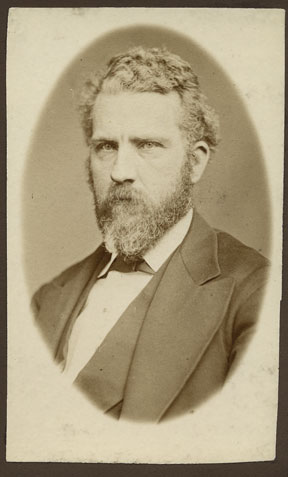
Dr. J. Suiter
Going back even further, I grew up knowing that my father's grandfather was a doctor who was a Civil War Veteran. Eventually I learned that great-grandfather did not enter the war as a doctor but rather went to Detroit Medical College after the war. (One day I should go up to Illinois and read his diaries!) The college is said to have been founded by physicians "whose work with wounded during the Civil War had left them eager to improve the quality of medical education."

My father's sister, who was the genealogist in the family, linked her mother's side of the family to William Morton, a key figure in the development of ether as an anesthetic. Ether and chloroform were important in Civil War surgery.

I knew even less about my mother's ancestors. Mom had mentioned that her grandmother once lived near Xenia, Ohio and talked about riding there in a horse-drawn wagon. This only came up when my daughter decided to go to college near there (at Antioch). And Grandmother Hammer had mentioned that an ancestor was a Presbyterian minister. It wasn't until 2010 that I looked up great-great-grandfather Robert Harper and found that he was not only a minister, but during the Civil War he was in charge of a hospital at Camp Dennison, Ohio. So I guess my interest in Civil War Medicine comes naturally!


May 29, 2012

Museum of Civil War Medicine

Our NVCC class visited the National Museum of Civil War Medicine in Frederick, Maryland. We were there once before but the museum has expanded since then and has even more dioramas to help you picture how the sick and wounded were cared for.

We had a guided tour which was excellent. Notice the wheel-layout of a hospital complex in the foreground of the first photo. That was used at Point Lookout in Maryland.

Once I got an email from a visitor to my CivilWarFieldTrips website asking about Civil War hospitals that can still be seen. There are so many — countless public buildings and private homes were used as hospitals, especially in Virginia which saw numerous battles between 1861 and 1865. Here are some I've written about in the past that are open to the public.
  1. Exchange Hotel in Gordonsville — fantastic, although the exhibit upstairs may be too graphic for some.  
  2. Graffiti House Museum near Culpeper, so called because of the graffiti left by soldiers.  
  3. Bushong Farm at New Market Battlefield  
  4. Old Court House in Winchester.  
  5. Chatham near Fredericksburg 
There are also many buildings used as hospitals that are open occasionally such as old churches and historic homes. Some examples are the Pritchard Farm and Moorefield Presbyterian Church. By the way, Alexandria Archaeology has just published some research on Crimean Ovens, which were radiant heating systems used in a few Civil War hospitals such as Shawnee Springs.

Search for Civil War Hospital on this blog.

May 28, 2012

Lecture at Mt. Zion Church


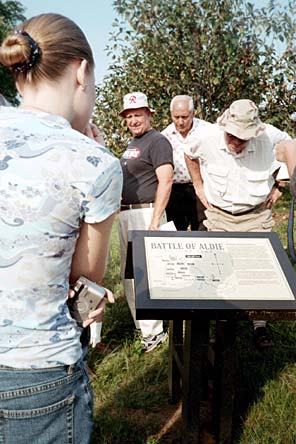
For the second day of our field trip series last week, we met at Mt. Zion Church near Aldie. Dr. Poland described the battle that took place there when Mosby's Rangers attacked Union troops. Both the church and a nearby farmhouse were used as hospitals to treat the wounded. It was common during the Civil War to use homes, churches, and other buildings as temporary hospitals.

A marker in front of the church tells us that:
On July 6, 1864 nearby, Mosby's Rangers attacked and routed 150 Union cavalrymen. Over 100 Union soldiers were killed, wounded or captured. Mosby had eight men wounded, one mortally."

May 27, 2012

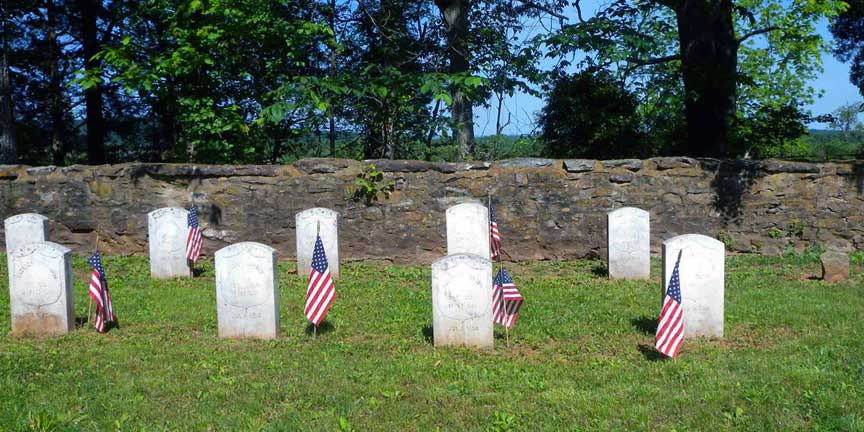
Mt. Zion Church and Cemetery

Mt. Zion near Aldie, VA


Here are markers for some of the Union cavalry men who were killed nearby in an 1864 battle with Mosby's Rangers.


May 26, 2012

Lecture on Chimborazo Hill

Prof. Poland lectures at an overlook, Chimborazo Park.

This year's series of NVCC field trips started at Chimborazo Park in Richmond. We were studying Civil War hospitals and prisons and Chimborazo was the site of a large Confederate hospital complex. Other stops that day were the Confederate White House, Belle Isle, and Hollywood Cemetery.

It was a lovely day for a tour and even though Richmond is a long day from home, I enjoyed going there again. It's a pleasant city to visit if you know where to go.
 Links:  

May 25, 2012

Powhatan Stone At Chimborazo Park

Richmond, Virginia

This marker is affixed to a large stone in Chimborazo Park. It refers to a belief that a Powhatan Indian village once stood beside the James River in present-day Richmond, giving its name to a colonial-era residence in 1726.
Powhatan Stone
An old Indian stone removed from and now overlooking “Powhatan Seat” a royal residence of King Powhatan when Captain John Smith and his fellow “Adventurers” made the first permanent English settlement in this country at Jamestown, Virginia 1607.

“Powhatan Seat” was the residence from 1726-1865 of the ancestors of Peter H. Mayo by whose daughters this stone was presented to the Association for the Preservation of Virginia Antiquities.

Views Looking Down from Chimborazo Hill


May 24, 2012

Chimborazo Hospital Complex, Richmond

A staff member in the museum at Chimborazo Park described the organization and structures at Chimborazo Hospital during the Civil War. Note the diorama showing various buildings of the hospital complex. They were built to allow fresh air and sunlight to penetrate each ward.

The military hospitals on both sides of the war had to be well-planned in order to serve the large number of patients that they received. Most patients were admitted due to illness rather than wounds because the incidence of contagion was tremendous in the large camps where soldiers were housed.

The sign behind the speaker explains that the hospital systems of the Civil War years became models for the American hospital system that we have today.

May 23, 2012

Visitor Center at Chimborazo Park

Our Richmond tour began at Chimborazo Medical Museum and Visitors Center, also headquarters for Richmond National Battlefield Park. The museum is definitely worth a visit, as is the pleasant surrounding park.

The interpretative sign provides a brief history of Chimborazo Hospital. It starts out:
On this 40-acre plateau the Confederates built Chimborazo Hospital, one of the largest and best-known Civil War military hospitals: 78,000 sick and wounded Confederate soldiers passed through the hospital from 1861-1865. Chimborazo’s neat rows of buildings enhanced ventilation and served as a model for many postwar hospitals. None of Chimborazo's 150 wooden structures exists today.

Jeff Davis's White House

Photography is not allowed in the Confederate White House in Richmond. This picture shows some of my classmates outside with the Museum of the Confederacy in the background.

The White House of the Confederacy is an interesting place to visit. You don't have to be a fan of Jeff Davis to enjoy it! The decor is authentically Victorian, not to modern tastes but historically significant. I love seeing the faux finishes, some of which look cool and some as tacky as Contact paper.


Visit Richmond's Hollywood Cemetery

Chapel At the Entrance: Buy a Map Here

Map on Sign Next to Parking Lot
I've been to Hollywood Cemetery several times on field trips. You can tour it by yourself but you'll want to buy a map because the roads can be confusing. I imagine you could drive in circles for hours.

The cemetery covers 135 acres of rolling hills. Famous people buried there include presidents Monroe and Tyler and 25 Confederate generals.


May 22, 2012

Sneden Civil War Illustrations are Online

The Virginia Historical Society has put the illustrations of Robert Knox Sneden online and it is an incredible collection. Most Civil War researchers are already familiar with Sneden's work; this collection will make it more accessible.

Personally I own two books based on Sneden's richly-illustrated diaries: Eye Of The Storm : A Civil War Odyssey and Images from the Storm. (Links provided will take Amazon's book descriptions.)

May 21, 2012

Our Class Tours Hollywood Cemetery

Frank and I have both been to Richmond with Dr. Poland's Civil War class before, and I'd even done that tour twice before that, once with his NVCC class and once with a UVA Graduate class that he taught on 19th Century Virginia. The tour this year (on Friday) had a different emphasis: Civil War Hospitals and Prisons. Richmond is a place where you can learn about both since it has Chimborazo Park (hospital site) and Belle Isle (prison site).

Since much of the Civil War is about tragedy and death, Dr. Poland's tours often include a cemetery visit. Richmond's Hollywood Cemetery is rich in Civil War history, and is also beautifully designed as a garden-like hillside park. Named after holly trees, it opened in 1849.
Confederate Memorial

Dr. Poland mentioned that some say the iron dog once stood in Richmond but was moved to the cemetery to keep it from being melted down to make cannons during the Civil War. It stands over a child's grave.

Funny thing about that dog: The Wikipedia entry about Hollywood Cemetery links to my 2001 photo of the dog in a footnote.
Dr. Poland at J.E.B. Stuart Memorial


Jeff Davis Monument


May 20, 2012

A Triple Tragedy for the Longstreets, 1861

Hollywood Cemetery, Richmond


The final stop on our Richmond tour was the grave site of three of General Longstreet's children who died of scarlet fever. They died within a week of each other, leaving their parents and an older brother to grieve.

This is an example of how devastating contagious diseases could be during the Civil War years. People did not yet know that germs spread illness and thus antiseptics were not understood and antibiotics were not yet available

May 19, 2012

A Cat, A Dog, and a Mouse

Hollywood Cemetery, Richmond, VA

Only the Cat is Real.
This laid-back cat was lounging near the cemetery entrance.
The cast-iron dog watches over a child's grave.
The toy mouse can be seen on the headstone above. (Look closely.)

May 18, 2012

How Do I Complain to Google?

I've looked at Google's Support pages and I can't figure out how to report a problem. Here's the situation and maybe someone can help me.

I searched for images of Mt. Zion Cemetery in Aldie, VA. Several of my photos came up among dozens of others, which is fine. I'm happy to have people find my pictures. BUT three-quarters of the way down the page of search results I see one of my photos credited to another site. That site turns out to be another search engine of some sort called Explow.com. Why is Google presenting results from another search engine anyway?

Thumbnails of my photos should link to my site (in this case www.CivilWarFieldTrips.com/stuart/), not someone else's. Someone tell me how to fix this!

By the way, our Civil War class returns to Mt. Zion Church tomorrow morning for the start of a field trip. And on Sunday we are going to the Museum of Civil War Medicine in Frederick, MD.

May 17, 2012

Benny at the Lake

Ben seems to like our new yard.